Field Research Vehicles
The University of Notre Dame’s pair of Field Research Vehicles (FRVs) are 9-ton vehicles equipped to support research and experimentation in wireless communications, radar, intelligence/surveillance/reconnaissance (ISR), electronic warfare (EW), and active/passive sensing. The vehicles were obtained with a DURIP grant from the Navy. The customized vehicles, were delivered to the University of Notre Dame in January 2015 and were operational in July 2015.

The vehicles feature telescoping (and locking) 42’ masts with a rotor mounted at the top and locations for antennas and RF equipment. Connectivity from the masthead to the equipment bay in the vehicle is achieved via a Nycoil conduit packed with 36 optical fibers, conductors, RF cabling, and Ethernet. Typically, the vehicles are configured with transceivers based on 2x2, 2x4, and 4x4 coherent MIMO architectures with RF equipment mounted on top of the mast and with optical fiber connectivity to a server in the FRV, enabling remote programming and control of the devices, and to transfer sampled complex baseband signals from the receiver at the masthead to the server in the equipment bay. Current RF capabilities extend up to 6 GHz but will be increased to 20 GHz.
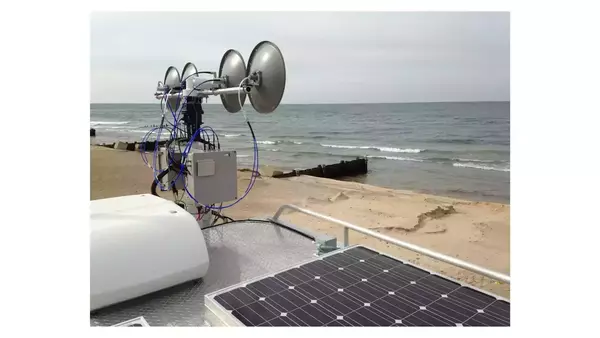
Various antennas (e.g., 470 MHz, 915 MHz, 2.4 GHz, 5GHz 10GHz, 18 GHz.) can be mounted either on the masthead or on the rails at the top of the vehicle. Azimuth/Elevation of the antenna rotor at the top of the masthead may be remotely controlled from within the FRV bay. Two wideband dual-pol open-boundary quad-ridged horn antennas are also available covering the entire band between 400 MHz to 6 GHz.
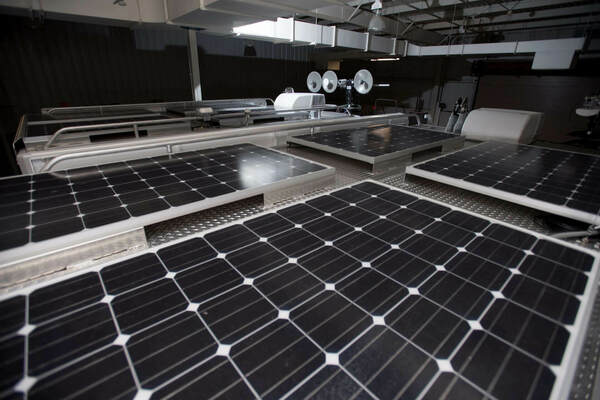
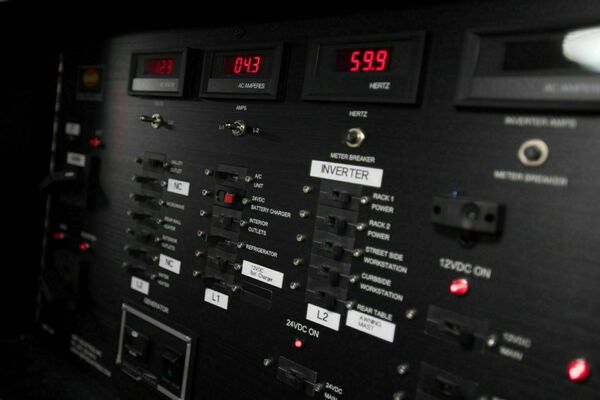
Power for equipment can be obtained from various FRV-based sources, including an onboard 12 kW generator, an array of rechargeable 12V batteries coupled to an inverter, rooftop solar panels (1 kW), and a wind turbine (600W). AC, 12V, and 28V and Ethernet lines are distributed throughout the interior of the FRVs and are also available at the top of the mast in the FRV cab.
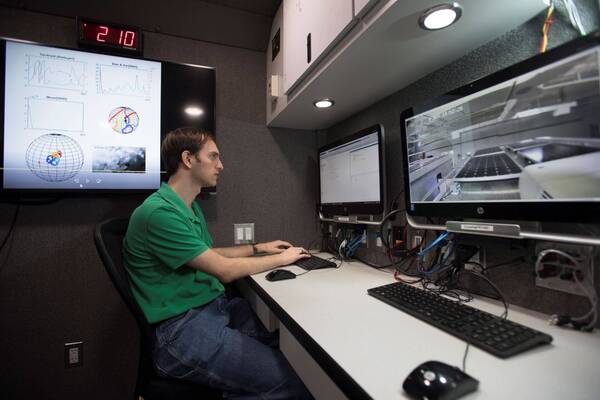
The trucks each have four workstations and a 50” monitor. Typical active displays in the bay include imagery from a camera mounted on the masthead, RF signal data products that are processed by the receiver system, and graphical user interfaces used to control equipment.
The vehicles are typically utilized with various transceiver systems: Ettus-based Software Defined Radio Transceivers (E310, X310, N310, etc.); a National Instruments phase-aligned 8x8 coherent MIMO transceiver system with FPGA arrays and RF capability to 20 GHz; a National Instruments 4x4 target emulation transceiver system with 1 GHz instantaneous bandwidths, an FPGA array, and operation up to RF frequencies of 6 GHz.