Ettus USRP-based transceiver systems
The RF Communications and Sensing Lab research team has developed three multi-channel systems which incorporate software defined radio devices from Ettus Research called Universal Software Radio Peripherals (USRP) which are described in more detail below. The measurement systems support dual-polarized transmission and reception as well as higher port count combinations of dual-polarized and space-polarized antennas. Such systems can be used in conjunction with Notre Dame’s field research vehicles or in a stand-alone capacity.
Each device has multiple RF transceivers (typically 2 or 4) and a large user-programmable FPGA. The RF transceivers/receivers have frequency coverage from 10 MHz to 6 GHz and up to 200 MHz per channel real-time bandwidth. Multiple devices can be used in parallel to provide systems with higher channel counts. The devices incorporate a high-speed digital connection to the host PC which allows for real-time streaming of measured data to storage.
The RF Communications and Sensing Lab research team has developed a streaming multi-channel software application for both transmitting and receiving data. For transmit, the application streams multiple coherent channels with independent arbitrary waveform files per channel. On receive, the application stores incoming streaming data to files for repetitive snapshot-based processing or for subsequent post processing. In order to extend the number of possible receive and transmit channels (which can be constrained by PC processing power or the PC/USRP interface), the application incorporates distributed operation across multiple PCs in a master/slave configuration such that it is possible to increase the number of transmit and receive channels without having to sacrifice streaming rates. We have also developed a separate control/display application (in MATLAB) for selecting data acquisition settings and for displaying processed data in a snapshot-based, continuous update mode.
There are several Ettus USRP's used in our research with various capabilities. Multiple USRPs can be connected to one or more host PCs to enable multi-channel coherent MIMO measurements. Synchronization among the USRPs is achieved in various ways in order to align the sample clocks and the local oscillators (LO) used for baseband up and down conversion. This synchronization is described further below. We have implemented several systems using multiple USRP's to provide high channel-count transceivers.
Ettus N310 distributed radar system
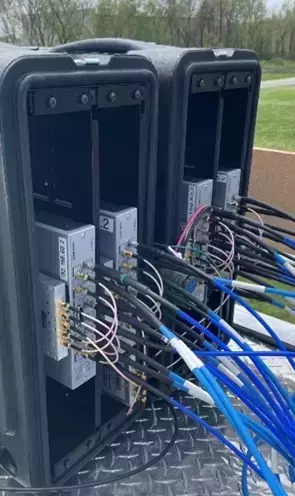
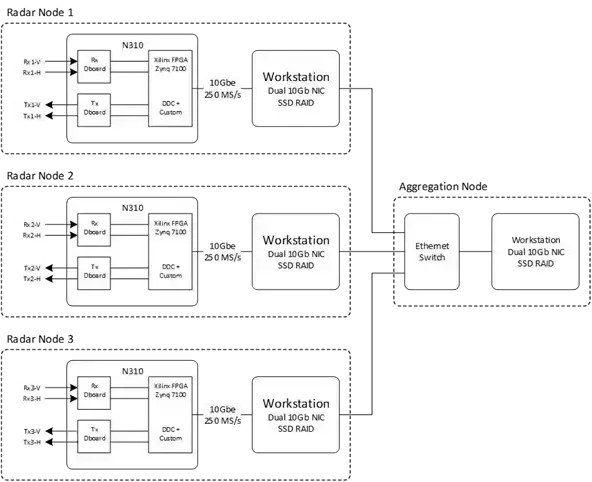
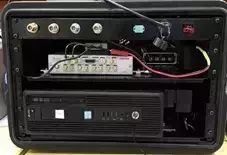
The first system is a distributed radar system incorporating three radar nodes based on the Ettus N310 USRP. A block diagram of the system and a photograph of a single radar node are shown below. This system can operate in the RF range 0-6 GHz with 100 MHz instantaneous bandwidth per channel. Custom FPGA and software implementations were developed to implement a linear FM modulated system with associated processing and displays.
Single-Shared LO and White Rabbit incorporated system
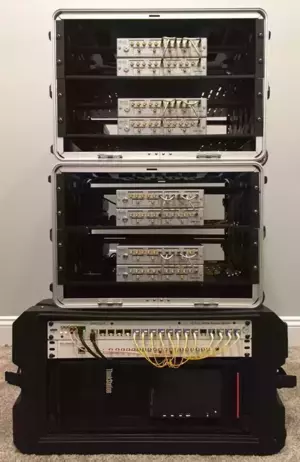
A second system was developed for the purpose of turbo-machinery monitoring and includes 16x16 capability implemented using eight Ettus N321 USRPs. This system incorporates a single shared LO and White Rabbit timing synchronization to provide highly coherent transmit and receive channels. For this application, the signal bandwidth was set to 25 MHz, but the USRPs have capability to operate at 200 MHz bandwidth.
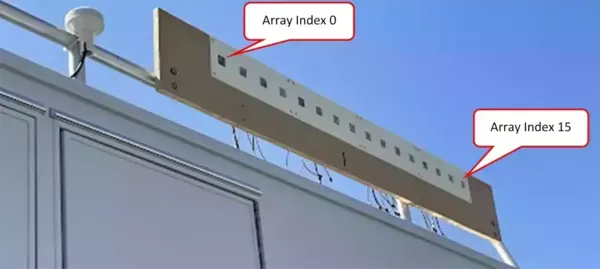
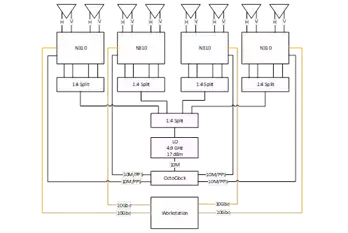
16-Channel Passive Receiver with 4 N310 Tranceivers system
The third system is a 16-channel passive receiver implemented with 4 Ettus N310 transceivers. The system was software controlled to switch configuration from a 16-element spatial array to an 8-element dual-polarized array. Additionally, the system operated with highly coherent channels using a single shared LO for downconversion of all channels.