UNDinia RFSoC-based 16x16 transceiver
The RF Sensing and Communications Lab maintains two Undinia RF-SoC based 16x16 transceiver systems. The Undinia 16x16 system is a coherent MIMO transceiver custom-designed by Fidus using the Xilinx ZU49DR UltraScale+ RFSoC to provide synchronous, multi-channel RF operation in three RF bands: 2.4 GHz, 5.8 GHz, and 24 GHz. This system provides 16 transmit and 16 receive channels in a 19-inch rack-mountable 6U form factor and includes interchangeable 4-channel RF frontend cards (with current RF cards available at 2.4, 5.8, and 24 GHz). The RFSoC provides direct RF-sampling data converters for frequencies up to 6 GHz. For the 24 GHz band, the RF card implements block up and down conversion utilizing an IF of 5.8 GHz.
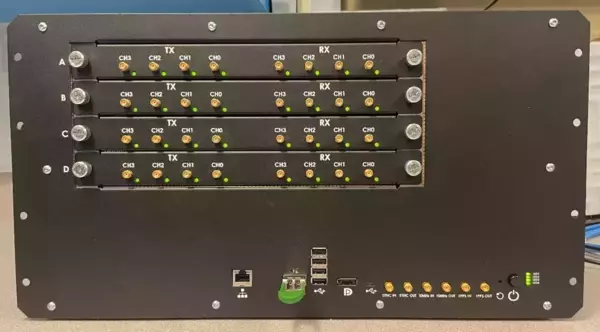
The system implements custom FPGA logic and RFSoC configuration parameters to provide operation in the three RF bands with approximately 230 MHz instantaneous bandwidth using a complex baseband sampling rate of 256 MS/s. For the receive channels, the RFSoC A/D is configured at 2.048 GS/s to provide direct RF-sampling in the 3rd Nyquist zone for the 2.4 GHz band or in the 6th Nyquist zone for the 5.8 GHz and 24 GHz bands (IF at 5.8 GHz). For the transmit channels, the RFSoC D/A is configured at 6.144 GS/s to utilize the 1st Nyquist zone for the 2.4 GHz band or the 2nd Nyquist zone for the 5.8 GHz and 24 GHz band. The RFSoC is additionally configured for 24x interpolation (transmit) and 8x decimation (receive) such that the FPGA complex baseband sampling rate is 256 MS/s in either case. Additional interpolation and decimation (provided in FPGA logic) is run-time selectable to reduce the baseband sampling rate in factors of two up to a maximum factor of 256 (minimum baseband sampling rate of 1 MS/s).
Two 32GB banks of DDR4 DIMM memory are connected to FPGA logic for the dual purpose of waveform playout (transmit) or capture (receive). For applications where DDR is not needed for waveform playout, both banks can be dedicated to capture providing a maximum capture depth of 64GB (16GS). Both playout and capture can be configured for 1, 2, 4, 8, or 16 channels. Ethernet file transfer to/from DDR is provided using TFTP protocol.
High speed Ethernet (100 Gbe) is provided via a QSFP28 interface for the primary purpose of real-time data streaming of the receive channels to an external host. With the 100 Gbe implementation, it is possible to stream up to 8 channels at the full 256 MS/s baseband rate or all 16 receive channels at a reduced rate of 128 MS/s. Streaming is packetized for transfer over Ethernet using VRT (VITA-49) UDP encapsulation. In addition to receive data streaming, the high-speed Ethernet also provides fast transfer of data to/from DDR memory.
The system provides several baseband streaming modes for real-time transmit and receive. Transmit streaming is possible using cyclic playout from either of two onboard memory regions: UltraRAM (max 4096 samples per channel) or DDR (max 8GS shared among the configured transmit channels). In either case, the full baseband rate of 16 channels at 256 MS/s is possible. There is currently no provision for real-time data streaming to the transmit channels from an external host. Receive streaming is possible in three modes: capture to onboard DDR, streaming to external host via QSFP28 interface, or streaming to onboard NVMe storage device. The latter mode provides storage up to 1TB with a maximum baseband rate of 64 MS/s (e.g., 16 channels at 4 MS/s or 4 channels at 16 MS/s). These three receive streaming modes provide flexibility for application-specific trade-offs of channel count, baseband sample rate, and memory depth.
The RFSoC incorporates both an application processing unit (quad-core Arm Cortex-A53 MPCore up to 1.33GHz) and a real-time processing unit (dual-core Arm Cortex-R5F MPCore up to 533MHz) along with 4 GB of DDR memory. The APU runs the PetaLinux operating system and provides custom-developed applications / utilities for configuration, control, and monitoring of the system. The system includes standard I/O ports such as USB and gigabit Ethernet (for networking or remote control). The user interface is a terminal window running ‘ssh’ over Ethernet or the Serial console provided over the micro-USB ‘debug’ port.